Taking off gel polish without damaging your nails
Peeling gel feels satisfying and costs your nails dearly. A patient soak off method and a little aftercare keep the nail plate intact.
Gel polish is made to last, which is exactly why taking it off needs care. When a manicure starts to lift at the edges, the temptation to peel it away is strong. Resist it. The few minutes you save can cost your nails months of recovery, while a careful soak off is far kinder to the nail plate underneath.
Why peeling does the damage
Gel adheres closely to the surface of the nail. When you peel or pick it off, it does not let go cleanly: it pulls away the top layers of the nail plate with it. What remains is thinner and weaker, and it often looks rough or patchy.
Because the nail plate is dead keratin, it cannot rebuild those missing layers. The damaged section simply has to grow out, and a fingernail takes roughly four to six months to grow out completely. Peeling a single set of gel can therefore affect how your nails look and feel for several months.
If an edge lifts before you have time for a proper removal, leave it alone rather than tugging at it, and plan the soak off for the next quiet evening. A lifted edge catches easily on hair and fabric, so keeping the nail filed short in the meantime helps to prevent accidental peeling.
The few minutes you save can cost your nails months of recovery.
What you need
A good soak off is mostly about preparation. Lay everything out before you start, because once your fingertips are wrapped, reaching for a forgotten tool becomes awkward.
- A fine or medium nail file, to break the seal of the
- Pure
- Cotton pads, cut into pieces slightly larger than your nails
- Kitchen foil cut into small squares, or reusable clips
- An orangewood stick or a cuticle pusher
- An oil or rich balm for the skin around the nails
- Cuticle oil and hand cream for afterwards
Acetone is highly flammable, so work in a well-ventilated room and keep it well away from candles, cigarettes and any other open flame. Protect your table, too, as acetone can mark some varnished and plastic surfaces.
The soak off method, step by step
- Protect the skin. Apply an oil or balm to the skin around each nail, keeping it off the gel itself, because acetone dries the skin.
- Break the seal. File the shiny top coat lightly until the surface looks matte. Stop there: the aim is to let the acetone in, not to file down to the natural nail.
- Soak. Saturate a piece of cotton pad with pure acetone and place it on the nail.
- Wrap. Fold foil snugly around the fingertip or secure the pad with a clip, so the acetone stays in contact with the gel.
- Wait. Leave the wraps on for about ten to fifteen minutes.
- Push gently. Remove one wrap and ease off the softened gel with an orangewood stick or a pusher, working from the base towards the tip.
- Repeat where needed. If gel still clings, rewrap that nail for a few more minutes rather than scraping hard.
Patience is the whole technique. Softened gel should lift away with light pressure. If you find yourself forcing it, the acetone simply needs more time.
Hard gel and builder gel are a different matter
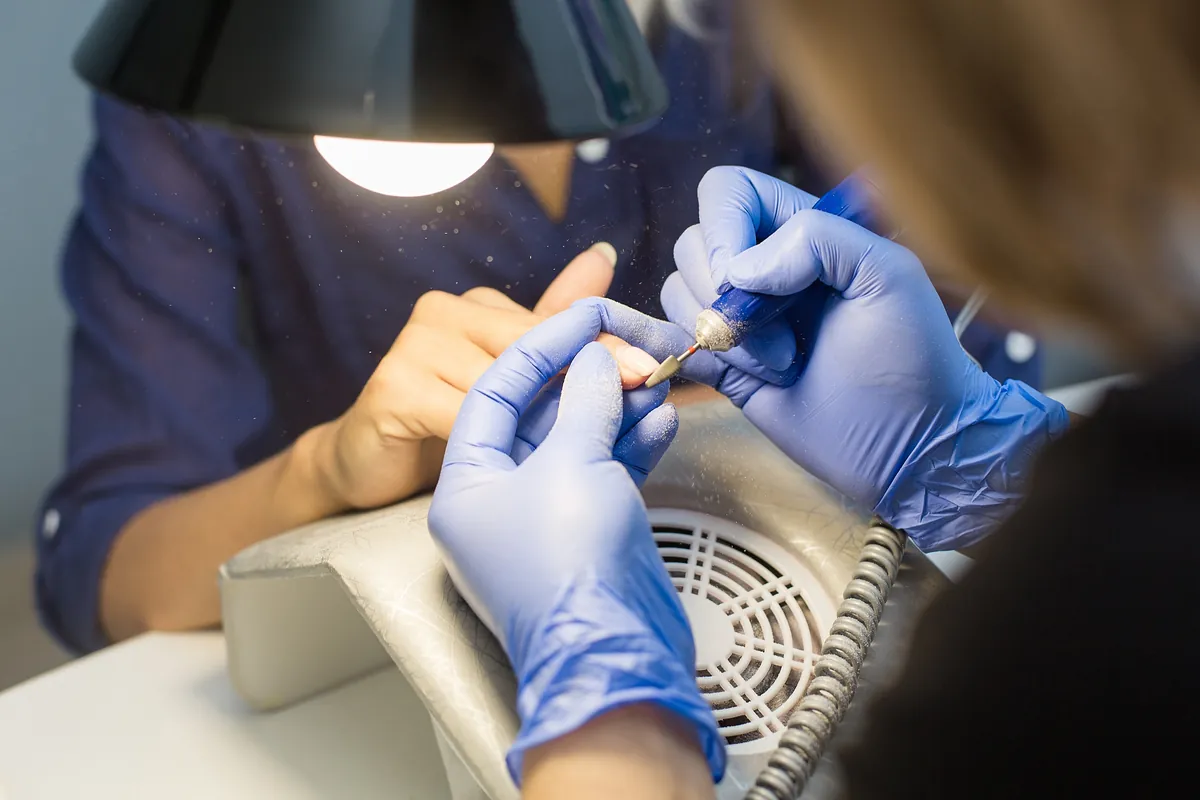
Not every gel product dissolves in acetone. Hard gel and most builder gels are filed off rather than soaked, and in salons this is often done with an . The skill lies in reducing the product layer by layer without reaching the natural nail beneath.
Filing off a hard product at home is risky, because it is difficult to see where the gel ends and the nail begins. If you are unsure which product you are wearing, ask the salon that applied it, and leave the removal of hard gel or to a trained professional. Removal on its own is a perfectly reasonable appointment to book, even when you do not want a new set straight away.
Helping nails recover
Acetone dries the skin, so finish every removal by washing your hands, then applying cuticle oil and a hand cream. Over the following weeks, a few simple habits help nails recover while the damaged part grows out.
- Keep nails short, so weakened tips are less likely to catch and split.
- Oil them daily, ideally before sleep.
- Protect them from water with gloves for washing dishes and cleaning.
- Avoid using your nails as tools while they are thin.
You may hear that nails need a break from polish so they can breathe. They do not: the nail plate is dead keratin, and the living parts of the nail are supplied through the blood, not through the air. A pause can still be useful after damage, simply because it lets you see the nail clearly and keep it short, oiled and protected.
If a nail becomes painful, lifts from its bed, or the skin around it turns red and swollen, stop doing your own removals and see a dermatologist or doctor.
Glossary
- Acetone
- A strong solvent that softens soak off gel polish; it is highly flammable and dries the skin.
- Top coat
- The final, shiny layer of a gel manicure, which seals the colour beneath it.
- Soak off gel
- Gel polish designed to soften in acetone so that it can be removed without filing it all away.
- Builder gel
- A thicker gel used to add strength or length; most types are filed off rather than soaked.
- Electric file
- A rotary tool used in salons to shape nails and remove hard products such as hard gel.
Questions and answers
What if the gel will not come off after soaking?
Do not scrape harder. Rewrap the stubborn nails with fresh acetone-soaked cotton and wait a few more minutes before pushing gently again. If the gel still does not soften, it may be a hard gel or a builder gel, which is filed off rather than soaked. In that case, ask a trained technician to remove it.
Do nails need a break from gel to breathe?
No. Nails do not need to breathe, because the nail plate is dead keratin and the living parts of the nail are nourished through the blood supply. A pause can still help after damage, because it makes it easier to keep nails short, oiled and protected from water while the weakened part grows out.
How long do damaged nails take to recover?
The damaged part of the nail cannot repair itself, so recovery means growing it out. A fingernail takes roughly four to six months to grow out completely. Keeping nails short, oiling them daily and wearing gloves for wet work helps them stay comfortable while the healthier new nail moves forward from the base.