Red nails: the story of a classic
From henna and ancient China to a famous campaign of 1952: why red became the most iconic nail colour, and how to choose and wear the right red today.
Fashions come and go, but red keeps its place in nail collections around the world. It suits evening dress and denim, short square nails and long almonds, and it reads as confident without any further decoration. To understand why, it helps to look at a long history of status, one famous advertising campaign and the simple optics of a strong colour on a small surface.
An ancient colour of status
Red on the nails was linked with status in several ancient cultures. In Egypt, henna stained fingertips and nails a warm reddish tone. In China, many histories describe tinted nails whose colours signalled rank. These early accounts are partly tradition, but they agree on one point. Coloured nails were never only decorative. They told others something about the wearer.
Coloured nails were never only decorative. They told others something about the wearer.
Red carries that message especially well. It is one of the most noticeable colours, it stands out against every skin tone and it can be read from across a room. On hands that gesture, hold and point, red draws attention to movement in a way that softer shades do not.
Red in a bottle
Modern red polish depends on opaque colour, and that arrived with Revlon. The company, founded in 1932, began with opaque nail enamels that offered solid, even shades instead of sheer tints. A strong red could now look the same from cuticle to tip, rather than appearing as a translucent wash.
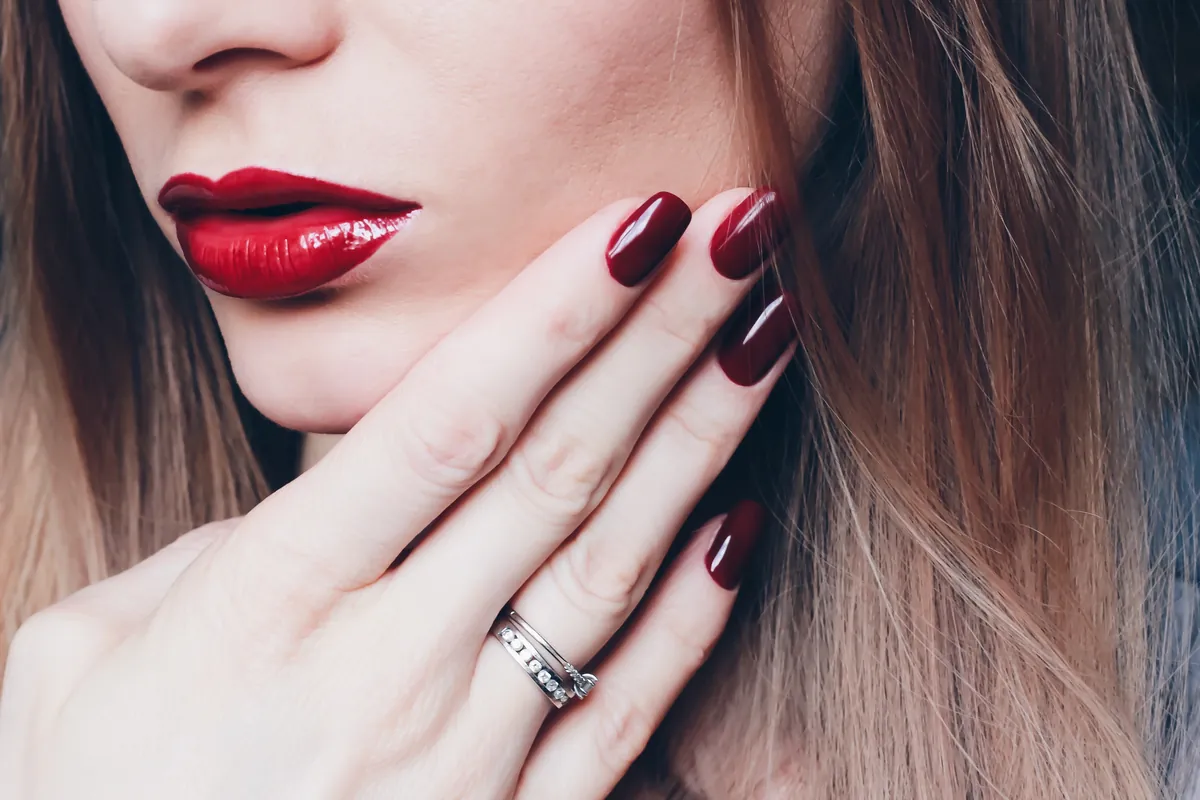
Revlon later promoted lipstick and nail colour as a matching pair. The idea seems obvious today, but it turned lips and nails into one coordinated statement, and red was the natural colour for it. A bright mouth and bright fingertips framed the face and the hands together, so the whole look felt planned.
Fire and Ice, 1952
The best known expression of that idea is Revlon’s Fire and Ice campaign of 1952. It presented a matching red for lips and nails, photographed by Richard Avedon with the model Dorian Leigh. The name itself set up the contrast: the heat of a bold red against the cool composure of the woman wearing it.
Campaigns of this kind helped fix red as the colour of glamour in the middle of the twentieth century. For decades afterwards, red lips with red nails stood for polish and self-possession, and the pairing is still instantly recognisable as a classic look. Many modern reds are, in effect, variations on that mid-century ideal.
Finding your red
Not every red flatters every hand, and the difference lies in . Reds lean either towards blue or towards orange, and that lean decides how they sit against the skin.
- Blue-based reds such as cherry and crimson flatter cool undertones. They look crisp and slightly jewel-like.
- Orange-based reds such as tomato and poppy flatter warm undertones. They feel sunny and energetic.
- Deep reds such as brick, and burgundy are calmer and more muted. They suit short nails and the heavier fabrics of autumn and winter.
A simple, if rough, guide to your undertone is the colour of the veins on the inside of your wrist in daylight. Bluish veins often suggest cool undertones and greenish veins warm ones. If you cannot decide, you may have neutral undertones, which can wear both families of red.
Red, reinterpreted
The full red manicure is only one option. Because the colour is so recognisable, even a small amount of it reads as a reference to the classic, which gives you plenty of room to play.
- Red French tips: a fine red line at the over a sheer or nude base, graphic and light.
- Jelly red: a translucent red with the glow of stained glass, softer than an opaque cream.
- Matte red: velvety and modern, especially in deep shades such as oxblood or burgundy.
- A single red accent: one red nail in a calm neutral set, a quiet nod to the classic.
Red works on the toes too, where a strong colour reads well even from a distance and pairs easily with open shoes. A red pedicure with a neutral manicure is a simple way to wear the colour when you prefer quieter hands.
Wearing red well
Red is unforgiving. It shows every uneven edge and every flooded cuticle, so preparation and clean-up matter more than with a nude. Strong reds can also stain the nail plate yellowish, especially when they are worn often. A prevents most staining and gives the colour a smooth surface to hold on to.
- Shape the nails, gently push back the cuticles and wipe each nail plate to remove oil.
- Apply a base coat to every nail and let it set.
- Paint a thin first coat of red, keeping a fine margin away from the cuticle.
- Add a second thin coat for full, even colour.
- Dip a small, flat in remover and trace around the cuticle and side walls.
- Finish with a glossy top coat, sealing the free edge of each nail.
Short, rounded red nails look modern and practical. Long almond or oval shapes lean towards classic glamour. Either way, the precision of the edges says as much as the colour itself.
Glossary
- Undertone
- The subtle warm, cool or neutral cast beneath a colour or a skin tone, which decides which shades harmonise.
- Base coat
- A clear first layer that helps polish adhere and protects the nail plate from staining.
- Clean-up brush
- A small, flat brush dipped in remover to correct polish edges around the cuticle and side walls.
- Oxblood
- A deep, dark red with a brownish cast, often worn in autumn and winter.
- Free edge
- The part of the nail that extends beyond the tip of the finger.
Questions and answers
Why does red polish stain my nails?
Strong red pigments can tint the surface of the nail plate and leave a yellowish cast, especially when red is worn often without a base coat. A base coat prevents most staining. If your nails are already discoloured from polish, the stain usually grows out with the nail. Discolouration that persists or is not linked to polish is worth showing to a dermatologist.
Which red suits short nails?
Almost any red works on short nails, as long as the edges are clean. Deep reds such as oxblood and burgundy look especially refined on a short, rounded shape, while a bright cherry or poppy feels fresh and playful. Keep the length and shape even across all ten nails, because red makes small differences easy to see.
How do I know whether I need a blue-based or an orange-based red?
Start with your undertone. Cool undertones are usually flattered by blue-based reds such as cherry and crimson, warm undertones by orange-based reds such as tomato and poppy. If you are unsure, paint one nail in each and compare them in daylight. Neutral undertones can often wear both, so let your wardrobe and the season decide.